
Other buildings
- Rothiemay Castle
- Mayen
- Avochie
- The Home Farm Steading
An hurry doon the stair;
It’s there to corn oor horses,
Likewise tae straik their hair.
Syne, efter workin half-an-hour,
Each tae the kitchie goes,
It’s there tae get oor brakfest
Which generally is brose*."

The Farm Steading.
Mains of Rothiemay or the Home Farm as it is locally known, began as the estate farm of Rothiemay Castle and remained part of the estate, latterly as a tenanted farm, until around 1963 when Rothiemay House was demolished. From 1741 until 1888 the estate was owned by the Duff family, who became the Earls and Dukes of Fife, and it was during this period, probably in the first half of the 19th. century, that the oldest part of present farm steading was built. The 25 inch O.S. map of 1870 shows the steading and adjacent barn and cottages but not the farm house which was probably added later when the farm was tenanted
In plan the steading building is quadrangular measuring 120 feet overall on each side, with a central entrance in the ornamental south side facing the main drive leading from the east gate lodge to Rothiemay House. It is a one and a half storey stone structure, originally consisting of byres, turnip sheds, stables, straw and hay lofts, cart sheds, and a water powered threshing mill, all grouped around a central yard and midden.
The estate stables and coach house were also accommodated in the south east corner of the building, and above the coach house there was a 'chaumer' for the single workers. This is still intact and consists of a small attic room with a gable window. The hay lofts on each side of it have disappeared however. From one of these there was a timber stair down to the farm stables. Presumably the first task of the day for the workers living in the 'chaumer' would have been to put hay down to the horses through the feeding holes which were in the floors of the lofts.
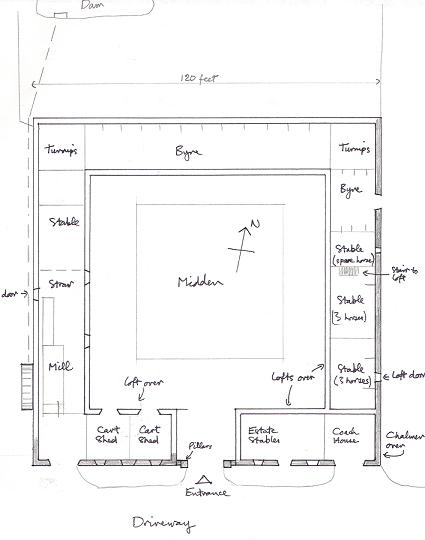
Originally the threshing mill was driven by an 'undershot' waterwheel outside the west wall of the steading. The mill was at low level and sheaves of corn were fed to it off carts via a high level door on the west wall. The water supply was taken from a field almost half a mile away to the north on the south side of Hassiehillock, and the water was stored in a dam on the north side of the steading, now partly covered by a Dutch barn. Not surprisingly the water supply is said to have been unreliable and would all but dry up in the summer time, and the wheel was replaced with tractor power and then an electric motor when they became available. The more recent introduction of the combine harvester made the threshing mill obsolete and the space is now used for grain storage and to accommodate a drier.
The stone walls of
the steading are basically of rubble and coursed rubble
construction mainly using stone gathered from the fields. While the back and side walls consist of
large irregularly shaped stones laid uncoursed with smaller
fragments making up the lime joints, more effort was put into the
south facade stonework which is coursed and roughly squared, with
lime mortar joints and black slate 'galleting'
accentuating the horizontal and vertical joint lines. Some of the
individual stones are purple or brown in colour instead of the
dark grey commonly seen in the walls of cottages and farms
locally. In contrast the quoins
and corner and opening rybats,
arch voussoirs and window and door cills and lintols on this
elevation are of coarse grained whitish granite as are the massive
granite pillars on each side of the central entrance. Presumably
this stone was brought in as the field gathered stone was too 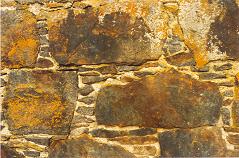 hard to dress accurately.