
Farming in the 18th Century

The New Road
Before the Battle of Culloden in 1746 there were no roads for wheeled vehicles in either Aberdeenshire or Banffshire, and all heavy loads had to be carried on horseback. The oldest properly engineered and constructed system of roads was made between 1746 and 1760 by military labour, and designated The King's Highway. The first two lines of modern roads (the one across the Eastern Grampians from Brechin by the Cairn O'Mount to Alford and Huntly; the other from Blairgowrie, by Braemar, Glengairn, Corgaff, and Tomintoul, to the Spey) were constructed, also by the military, about 1754. The latter is still known as General Wade's Road.
By the Acts of 1617, 1661, and 1669, the Scottish Highways or Roads
were ordained to be made and maintained by Statute Labour, which the
labouring population were liable to be called out to give to the
extent of six days yearly, on the roads in their respective parishes.
The work done on this principle of forced
labour was seldom executed efficiently. The roads were narrow
tracks constructed mostly of the materials of the ditches cut along
their sides. The wet portions were filled up with earth and stones,
and were rarely causewayed, so that in bad weather they were apt to
become almost impassable through the accumulated depth of mud.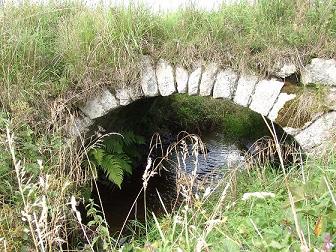
The "Turnpike and Road Commutation Act" of 1794 converted or "commuted" the yearly six days of Statute Labour into a money payment. A man's labour was then reckoned at only threepence a day. The earliest Scottish Turnpike Act was passed in 1750, but no turnpike road was made in either Aberdeenshire or Banffshire till 1796. Between this date and the year 1810 all the main turnpikes in the two counties were constructed. They were metalled, but the stones forming the base were twice or thrice the size of those introduced in 1816 by the famous road maker, Macadam. By Macadam's system the stones were not to exceed six ounces in weight, but stones of from one to two ounces were preferable. On the old road tracks a horse could not draw more than three cwt., but on the improved roads the weight was increased to seventeen cwt., or even a ton. The farmers at first opposed the making of turnpike roads, thinking the tolls would ruin them, and that the roads would cut up their fields and make them an inconvenient shape for ploughing. But soon they found the benefit, for they could transport on the new roads, with the same horse power, twice or thrice the weight of load they could do before.
For example the mail coach between Edinburgh and London took seven days in 1750, and only three in 1780. In 1808 the first public coach in the north, called "The Fly", started and ran between Aberdeen and Huntly, taking a single day in the journey, and returning the next. It was conducted by a Mr. Scorgie, and carried only two or three passengers. Next year he started what was called "The Caravan Coach", which carried more passengers, and performed the double journey in one day. As an example of the slowness of the Postal Service, in 1810 the "Aberdeen Journal," containing the exciting news of the Peninsular War, did not reach Haddo, in the parish of Forgue (nine miles distant from the post towns of Turriff and Huntly) till Friday - two days after its publication. In 1819, and for some years thereafter, the mail coach which left London on Monday with that day's newspapers, did not reach Aberdeen till the following Thursday afternoon, it being reckoned a great increase in speed when it arrived on Thursday morning.